When Things Don’t Quite Go to Plan

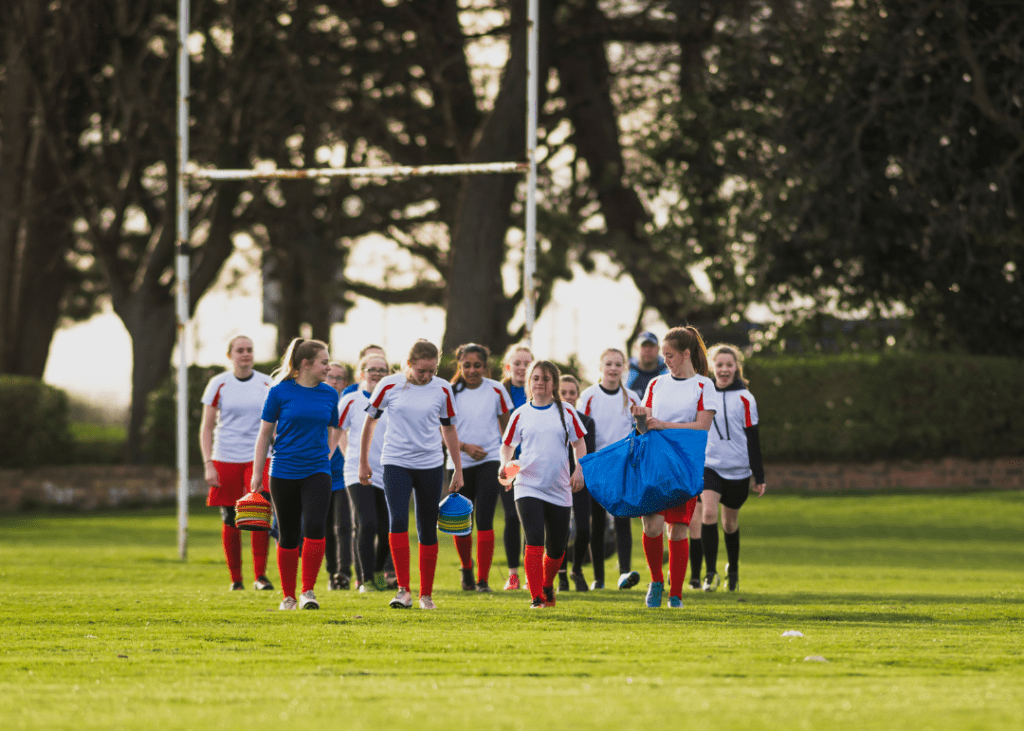
I was standing on the edge of a very soggy rugby pitch over the weekend, hands tucked into pockets, watching rain clouds roll in, thinking, well… this wasn’t quite the plan.

It’s been a familiar refrain lately. Weeks of persistent rain. Cancelled sessions. Constantly checking pitch inspections. That low-level uncertainty that comes with trying to organise anything outdoors in a British winter.

The girls I coach had been desperate to train. After a strong performance the previous weekend, their confidence had lifted and their energy was up. They wanted to build on it. As coaches, we felt the same – not to overhaul anything, just to keep a rhythm going.

When we arrived, the pitches told a different story. Standing water. Ground that looked fine from a distance but squelched underfoot the moment you stepped on it. We adapted. Shifted cones. Shrunk the space. Moved again. Some of it worked. Some of it didn’t.

Then the rain properly arrived – the kind that seeps into gloves and socks and patience. A few complaints about the cold followed. Fair enough.

And then, almost mockingly, the sun came out. Not enough to warm us. Not enough to dry anything. Just enough to change the feel of the moment.

What stayed with me afterwards wasn’t the resilience of the girls, though that was there, but how quickly I’d noticed my own mind tightening earlier on. Wanting things to go smoothly. Wanting the session to count. Wanting conditions to cooperate so progress could be made.

Understandable, but quietly exhausting.

There’s something humbling about watching plans dissolve in front of your eyes. You’re left with what’s actually here, whether you like it or not. The pitch. The weather. The mood. Yourself.

As the session unfolded, I found myself really getting into it, my mood lifting. The usual confident players did their thing. Others stepped forward too. There was effort, yes – but also laughter. Mud everywhere. And connection. We ended up with a decent spell of rugby that no amount of planning could have guaranteed.

Reflectin at home later, I noticed how familiar that pattern felt. At work. At home. In the quieter corners of my own life. We carry an idea of how things should unfold, and life pays polite attention before doing something else entirely.

The sun coming out didn’t fix anything. The pitch stayed wet. The cold lingered. But something had eased internally. A loosening. A reminder that conditions change – and that some of the pressure we feel comes from how tightly we’re holding onto the outcome.

I’m not sure there’s a lesson in that. Or at least, not a neat one.

Just a muddy, wet and cold day that’s stayed with me. Quietly asking what it might be like to trust the unfolding a little more. To meet what’s here with a bit less urgency.

I wonder where that might be true for you right now. Where the weather isn’t cooperating. And what might become visible if you paused, looked up, and noticed what’s still happening anyway.

Why Do I Do This?

I was listening recently to a conversation between two colleagues, Hakan Akbas and Mbulelo Mthi. I didn’t go into it expecting anything in particular but something in the way they were speaking stayed with me. Not in a dramatic, life-altering way – more like a quiet nudge. The kind that lingers and keeps tapping at your shoulder.

It left me sitting with a question that’s been hovering around the edges of my work for a while.

Why do I do this?

Why do I spend time thinking, writing, sharing and having conversations that don’t always lead anywhere obvious?

Conversations without neat endings or clear takeaways. Is it because I enjoy it? Because it feels meaningful? Because, occasionally, someone says it helped them see something differently?

And when it doesn’t land – when there’s silence, or indifference, or a sense that it simply passed by unnoticed – what do I make of that?

I notice how quickly my mind can turn those moments into something personal. A quiet judgement. A question about competence, usefulness or credibility. I wonder whether I treat those moments as information… or as evidence.

In the conversation I was listening to there was a subtle exploration of service. Not service as effort or self-sacrifice, but as an orientation, a place to stand. Something about that resonated with me.

What changes when the question isn’t Did this work? but What was I bringing to it?
What shifts when usefulness isn’t measured by outcome alone?

I can feel how easily I get pulled toward results, toward wanting something to land, to justify the time or energy. There’s a quiet pressure in that. A narrowing, and perhaps a kind of urgency that makes listening harder. Alongside this, I’ve been noticing my relationship with visibility. For a long time, I stayed fairly quiet, not because I lacked interest, but because I cared. About getting it wrong. About being misunderstood. About being seen and found wanting.

It was easier to wait. To tell myself I was gathering clarity, or refining things, or simply being patient.

Lately, I’ve been experimenting with not waiting so much. Sharing thoughts while they’re still forming. Letting conversations be conversations, rather than vehicles for something else. Watching what happens when I don’t rush to decide what it all means.

Built With Intention has been part of that… not as something to push forward, but as a way of paying attention. A lens for noticing how and where I’m coming from when I speak, write or listen.

What I’m noticing isn’t a conclusion so much as a difference in feel. When I’m less concerned with protecting myself or proving something, there’s more room. Less grasping. A softer relationship with uncertainty and with whatever response comes back, or doesn’t.

I still hesitate. I still notice the pull toward safety and certainty. But I’m less inclined to treat that as a problem to solve. It feels more like something to notice, then sit alongside.

So I keep returning to the same question. Not to answer it, and not to resolve it, just to stay close to it.

Why do I do this?

And what might open up if the question itself is allowed to do the work.

Sunshine Saturday: What’s Really Fueling Your Experience?

In the travel industry, the first Saturday of the new year is known as Sunshine Saturday. It’s the day when bookings spike as people lock in summer holidays and give themselves something bright to look forward to. The festive bubble has burst, inboxes are full again and here in the northern hemisphere the days are short, cold and, if you’re in the UK, reliably damp. Dreaming of blue skies and warm evenings can feel like a lifeline.

And it works. At least, it feels like it does.

But I’ve found myself increasingly curious about what’s really going on in moments like that. Is it genuinely the future holiday that’s lifting our mood or is something else at play – something much closer to home and far more accessible?

The promise of sunshine

There’s nothing wrong with booking a holiday. I love having trips in the diary myself. That sense of anticipation can feel energising, especially when life feels a bit flat. Yet if we slow down for a moment, it’s worth asking where that lighter feeling is actually coming from.

The plane ticket hasn’t changed anything yet. The weather outside is the same. Work hasn’t eased off. And yet, inside, something shifts.

That question – what really creates our experience of life – has been quietly shaping how I see the world for several years now.

A different way of understanding experience

This way of looking at things first opened up for me when I was “restructured” out of a role at work. A colleague handed me a copy of Clarity by Jamie Smart. I’ve read it several times since, and I’ll be honest: the first read made sense mainly at an intellectual level. It felt interesting, even logical, but also slightly out of reach.

I kept trying to think my way into a deeper understanding of what Jamie was pointing to. That approach didn’t get me very far, or at least it didn’t last. Over time, and especially through working with my own coach who trained with Jamie, something began to settle in a more lived, practical way.

The core insight is simple, but not always easy to see at first: our feelings don’t come from our circumstances. They come from our thinking in the moment.

What this looks like in real life

This doesn’t mean life suddenly becomes smooth or that bad days disappear. They don’t. I still have moments of frustration, and I can still be grumpy enough to test the patience of those around me. Fitness helps, rugby helps, getting outside helps – but none of those are magic fixes.

What has changed is how quickly things pass. When I’m irritated, it doesn’t hang around as long. When a low mood turns up, it feels less personal and less permanent. I’m not trying to “fix” it or analyse it away. I’m more willing to let it move on in its own time.

It’s also clearer to me now that the things we point to as the cause of our feelings – a comment, a result, the weather, a lack of sunshine – aren’t the source. They’re the content of our thinking, not the engine behind it.

Sunshine Saturday is a great example. It’s not the holiday that lifts the mood. It never is. It’s the hopeful thinking that briefly shows up alongside the idea of it.

Perspective under pressure

This can sound glib if it’s not grounded properly, and that’s not my intention. Some people face challenges that are genuinely overwhelming. This understanding isn’t about minimising that.

One of the clearest illustrations of this perspective comes from Viktor Frankl, the Austrian psychiatrist who survived Nazi concentration camps during the Second World War. In unimaginable conditions he observed that while everything could be taken from a person, one thing remained: the freedom to choose how to respond internally. His experience didn’t make suffering disappear but it showed that even there the source of experience was not purely external.

That’s not a benchmark to live up to, but it is a reminder of what’s possible.

As the year unfolds

As we move through the foothills of 2026, with summer still feeling a long way off, there’s nothing wrong with dreaming of warmer days. If that lifts your mood, enjoy it. Book the trip, browse the photos, imagine the sea.

Just remember this: the feeling isn’t coming from the future. It’s coming from you.

As Wayne Dyer put it, when you change the way you look at things, the things you look at change. Seeing that for yourself, even briefly, can make a quiet but lasting difference.

Steady Progress – Where the Magic Really Lies

During December I got a notification to say that I had reached 50 blog posts. It caught me slightly off guard. I knew I had been writing more consistently throughout 2025, but I had not clocked that it had added up to fifty. When I thought about it properly, it made perfect sense – roughly one post a week for the year. Nothing heroic. Nothing dramatic. Just showing up.

What that small notification really highlighted for me was something I have come to see again and again. Consistency is where the magic lies.

The quiet power of showing up

In The Slight Edge, Jeff Olson talks about how the slight edge is always working, either for us or against us. There is no standing still. That idea has stuck with me because it feels so true when I look back on my own life. Progress is rarely the result of one big moment. It is the accumulation of small, often unremarkable actions taken consistently over time.

I can also see the opposite. There have been periods where I have become comfortable and subconsciously sat back to admire what I had created. Nothing obviously went wrong at first. But a few months later, or sometimes a couple of years, I would look around and realise that a quiet kind of atrophy had set in. Use it or lose it, as the saying goes. Not through failure or drama, just through a lack of movement.

Why consistency beats intensity

We are often drawn to big moves. Grand plans. Short bursts of effort that promise fast results. They are exciting and they make for good stories, but they rarely last. Consistency on the other hand does not ask for heroics. It asks for commitment.

Doing something regularly, even when motivation is low, builds a rhythm. That rhythm reduces friction and over time it becomes part of who you are rather than something you are trying to force. Whether it is writing, training, coaching, learning or leading, steady progress consistently applied compounds in ways that are hard to appreciate day to day, but impossible to ignore in hindsight.

That realisation is exactly what that simple note about fifty blog posts gave me. It was not about the number. It was about the pattern behind it.

Direction still matters

Consistency on its own is not enough. If you are consistent but heading in the wrong direction, you simply get very good at something that does not serve you. This is where clarity comes in.

I see this a lot… people work hard, stay busy and pride themselves on effort, yet feel stuck or frustrated. Often the missing piece is not motivation but intention. Where are you actually heading and why does it matter to you?

This thinking is a big part of why I created my new coaching programme, Built With Intention. Consistency is the engine, but direction sets the course. Once you have a sense of where you want to go, small daily actions start to align naturally. They stop feeling random and begin to make sense.

Pausing without stopping

One of the misconceptions about consistency is that it means never stopping or questioning yourself. In reality the opposite is true – pausing to take stock is part of staying consistent over the long term.

Regular reflection allows you to notice what is working, what is no longer serving you and what might need adjusting. The key is that the pause is intentional and not an excuse to drift. You can change direction without abandoning momentum.

The long game

Hitting fifty blog posts did not change my life but it did remind me of something important – meaningful progress is usually quiet. It rarely announces itself until you look back and join the dots.

Here’s to the next fifty. Not rushed. Not forced. Just built steadily, with intention.

Pruning for Progress

I came across a post on by Steven Bartlett Facebook the other day that caught my attention. One of those deceptively simple posts that seems obvious at first glance. My initial reaction was, “Yes, that feels true.” Then I read the comments and the idea took on more depth and nuance than I first expected.

Those comments reminded me of a book I read some time ago called The Pumpkin Plan by Mike Michalowicz. In it, Michalowicz compares building a successful business to growing award-winning giant pumpkins. The key insight is not about adding more. It is about removing. To grow one exceptional pumpkin you have to cut away the others. Those smaller pumpkins might look promising but they drain nutrients from the one that has the real potential. If you leave them all, none of them truly thrive.

Several comments under Steven’s post pointed to this principle in gardening. Healthy growth is not just about watering and feeding. Timely, thoughtful pruning encourages stronger, more vibrant results. Cut back the right things, at the right time, and the whole plant benefits.

That idea translates easily into life, sport and work.

As a coach, both in a personal sense and on the grassroots rugby pitch, I see this regularly. We often focus on what we should add. More sessions, more conversations, more commitments, more effort. Rarely do we pause to consider what might need pruning. What is quietly draining energy without offering much in return.

Most of us can think of people, habits or expectations that have this effect. Individuals who find fault in what we do, question our intentions or consistently ask more from us than they give back. This is where the topic becomes uncomfortable, because it is easy to drift into extremes. Cut people off. Walk away. Be ruthless.

That is not what I am advocating.

There are many situations where giving, even when it is not balanced, brings genuine satisfaction. Parenting, volunteering, coaching young players, supporting friends through difficult periods. These relationships are not transactional and they should not be treated as such. The challenge arises when giving happens against a backdrop of resistance, negativity or obstruction. When you start to feel depleted, frustrated or wondering why you bother at all.

When that happens, I try to return to first principles. Why am I doing this? What matters to me here? What is actually within my control?

This is where a simple idea from Mel Robbins has been helpful. Let Them. Let people think what they think. Let them say what they say. Let them behave how they choose to behave. Then comes the more important part. Let Me. Let me act in line with my values. Let me invest my energy where it makes sense. Let me step back from what undermines healthy growth.

In a grassroots rugby environment, this might mean spending less time trying to persuade a resistant parent and more time supporting players who are open, curious and committed. In work, it could mean saying no to projects that look attractive but pull you away from what you do best. In life, it might involve creating a bit more distance from conversations that leave you feeling drained rather than steady.

Pruning is not about punishment. It is about clarity. It is about protecting what matters so it has the space to grow.

If there is one simple takeaway, it is this. When you feel stretched, frustrated or stuck, ask yourself what needs cutting back, not what needs adding. Progress often comes not from doing more, but from choosing more carefully.