Blog

The Distance Between You and the Outcome

I was listening to an interview between Jamie Smart and Steve Chandler the other day. Steve was talking about outcome goals and process goals and it got me thinking about how often we lean heavily on the outcome.

It’s a familiar pattern. We sit down, often at the end of the year or when something in life nudges us, and we think about what we want to be, do or have at some point in the future.

On the surface that seems sensible. It gives us direction. Something to aim at.

But what I’ve noticed, both in myself and in the people I work with, is how easily that focus on the outcome can start to work against us.

Because the outcome lives at a distance.

When we measure ourselves against something far away progress can feel invisible. You don’t suddenly feel fitter after a few workouts. You don’t instantly see a full pipeline after a handful of calls. From where you’re standing it can look like nothing is happening.

That’s often where motivation dips. It’s where doubt creeps in, and it’s where people quietly move on from the goal altogether, or decide that goal-setting just isn’t for them.

The distinction Steve was pointing to – the part that’s been useful for me – is the shift towards process goals.

Outcome goals still matter – they set the direction. But process goals are where movement actually happens. They bring things back to something concrete. Something you can do, repeat and measure in the short term.

Instead of “get fit”, it becomes showing up for a certain number of sessions each week.
Instead of “grow the business”, it becomes making a set number of calls or having a set number of conversations.
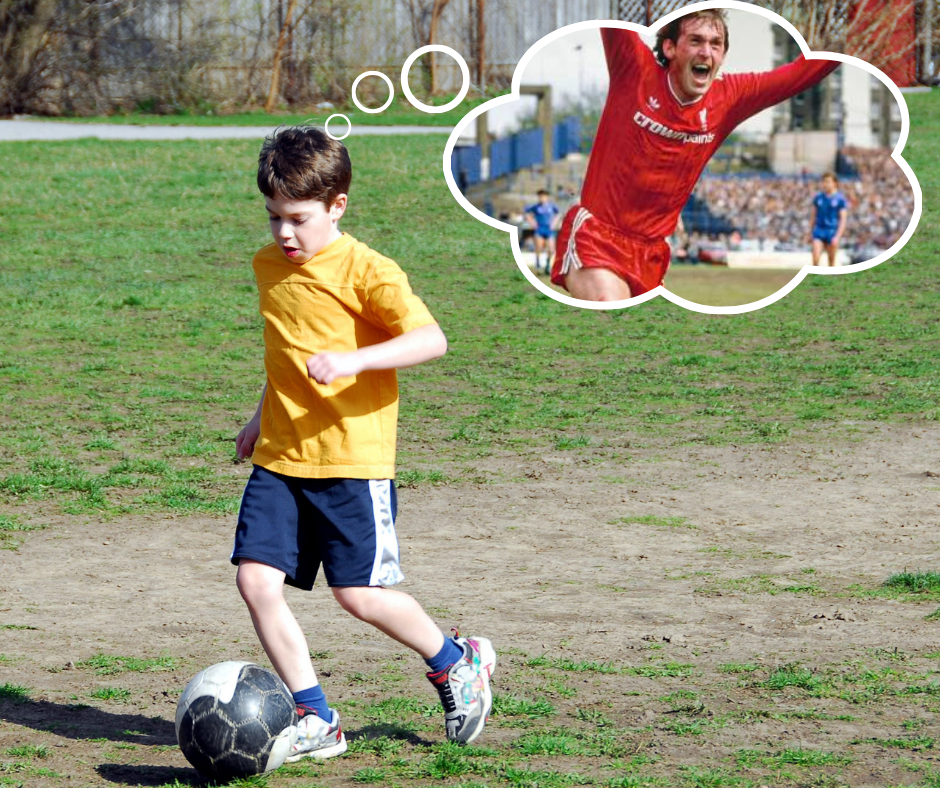
Instead of “become a better player”, it becomes the number of passes, kicks, or drills you put in.

I see this a lot with the girls’ rugby team. The biggest improvements don’t come from talking about winning matches or league position. They come from the repetition of simple actions: turning up, practising, making the next pass, getting back into position. Over time those small things compound and often we reach out goal quicker than we’d expected, or we learn more that we hoped.

There’s also something important that shifts psychologically.

When the focus is purely on the outcome, the comparison is always between where you are now and where you think you should be. And that gap can feel discouraging.

Process goals change the reference point.

Instead of asking, “Am I there yet?”, the question becomes, “Did I do what I said I would do today or this week?”

It’s a quieter measure, but a more reliable one.

Over time, it gives you something tangible to build on. You can adjust it, increase it, refine it. If progress isn’t showing up in the way you expected, you’ve got something to look at. You can ask whether the volume is right, whether the approach needs tweaking, or whether the process itself needs to change.

None of that is really possible when everything is tied up in a distant outcome.

I’m still working this through myself, but it does seem that when goals start to feel heavy or frustrating, it’s often a sign that the balance is off.

The outcome is still doing its job… it’s pointing somewhere.

But the real work, and most of the momentum, sits much closer in.

In the reps.
In the small, repeatable actions.
In the next thing that can actually be done.

Just out of sight

Out for a walk the other morning on a path I know well, I found myself stopping as an image came to mind.

At the halfway point, I turned around and looked back up the hill I’d just come down. The path curved gently away around a bend, disappearing from view. I took my phone out and captured it, though I’m not sure the photo quite held what I’d seen.

There was something in that moment.

We spend so much of our time looking ahead, trying to see the path in front of us. It’s rarely straight. There are bends, rises, dips, bits you can’t quite make out. And yet, somehow, we’re always standing here, wherever “here” happens to be, having already travelled a version of that same kind of path.

All those turns. All those stretches where we couldn’t quite see what was coming. And still, we arrived.

I stood there for a bit longer than usual, looking up the hill. Wondering, I suppose, where that path actually leads. Not the literal one – I know where that goes – but the bit just out of sight. Around the bend. Over the rise.

The truth is, I didn’t really know what was up there. I just knew that if I kept walking, I’d find out when I got there.

I might be wrong, but it feels like life has a similar rhythm to it. We keep moving even with the uncertainty. Even with the moments where we pause or hesitate. And yet, if I look back properly, there’s a long list of things I’ve already found a way through.

It’s easy to forget that. Easy to get caught standing still, looking ahead and wondering if we’ve got what it takes for whatever’s coming next.

I’ve been dipping into a book recently by a friend, Stan Horwitz. He writes about the pace of change in the world, particularly with AI, and doesn’t really soften it. There’s a lot in there that could feel unsettling if you sit with it for too long. But there’s also something else running through it… a sense that there is still a place for us in all of this.

Not by standing back, but by stepping into it. Figuring it out as we go.

That idea seemed to echo what I’d felt on the path this morning.

We don’t get to see the whole route laid out in advance. We never really have. And yet we keep going. Step by step. Sometimes confidently, sometimes not so much.

Maybe it’s less about knowing what’s around the bend, and more about remembering that we’ve walked enough paths already to trust ourselves with whatever we find when we get there.

I stood for a moment longer, then turned and carried on up the hill.

How’s Your Building Going?

As we reach the end of the first quarter, I’ve found myself taking stock.

Not in a dramatic, tear-it-all-up-and-start-again kind of way… just a quiet check-in.

And if I’m honest, I noticed something creeping in.

I’d been letting a bit too much of the outside world into my inside world.

The constant stream of news. The background noise of conflict and rising costs… and then more personal things like a property sale falling through right near the end, sending us back to square one.

None of it unusual. All part of life.

But together, it started to create a wobble.

A subtle shift.

I caught myself looking ahead and wondering how things were all going to play out.

And without really noticing at first, that question pulled me into a feeling of scarcity. Tightness. Uncertainty.

Which is interesting… because if I step back, I know that’s not the reality I’m living in.

So yesterday evening, I paused.

Not to fix anything. Just to look.

I went back to the foundations and asked myself a simple question:

Where am I, really?

And the answers were all there.

A loving wife and three brilliant girls.
A warm, dry home.
Food on the table.
Work that supports us.

When I looked properly, nothing had changed… except where my attention had been.

That was the moment it clicked again.
Awareness of the world matters — of course it does.

But when we let it dominate our thinking, it starts to build a life for us… rather than us building the life we actually want.

And that’s the bit that matters.

Because whether we realise it or not, we’re always building.

The question is – are we doing it with intention, or by default?

What this week reminded me is something I already “know”, but clearly needed to feel again:
I get pulled off track. I drift. I get caught up in things that aren’t mine to carry. But I can also come back.

And when I do – when I shift my focus back to what’s real, what’s here, what I’m creating – the fog lifts.
Not forever. But enough.
Enough to keep building.

So as we reach the end of March, it’s a good moment to pause and ask:
How’s your building going?
Is it taking shape in the way you’d hoped?
Or has it drifted a little?

If it’s the latter, you’re not alone.

And the good news is – it doesn’t take a complete overhaul.

Sometimes it just starts with a conversation.
That’s exactly why I created Built With Intention.

Not as a fix, or a formula… but as a space to step back, take stock and consciously shape the life you’re building.

If that feels like something that would help, feel free to reach out for a chat.

“Inspiration is for amateurs.”

I saw a clip of Jimmy Carr saying that on stage and almost without thinking I wrote it down.

Not because I had anything clear to say about it at the time. It just felt worth keeping.
A line like that can go a couple of ways, I think. You can take it at face value and move on. Or you can catch something underneath it… something a bit more practical than it first sounds.

From what I remember, he was talking about his process. Writing constantly. Trying things out in small moments at the end of shows. Seeing what works, what doesn’t and adjusting from there.

No big reveal. No waiting around for the perfect idea.

Just doing the work in front of people and letting that shape what comes next.

I jotted a few thoughts down after hearing it. Nothing polished. Just fragments, really. Then left it. Came back to it a day or two later to see if there was anything in it.

Which, thinking about it now, feels quite close to the point he was making.

There’s something in the gap between what we think might work and what actually does, and the only way across that gap is to try something and see.

I used to spend quite a bit of time on the thinking side of that line.

Turning ideas over. Adding to them. Tweaking the wording in my head before anything ever made it onto the page. It felt productive at the time – like I was getting somewhere.

But very little ever moved beyond that.

What I’ve noticed more recently is that the act of starting, even when it’s a bit clumsy, changes the whole thing.

A sentence written down has a different quality to a sentence imagined. It’s easier to see what’s there. Easier to see what isn’t.

Sometimes something that felt sharp in your head looks a bit flat on the page. Other times it holds up better than expected. Either way, you get something to work with.

And that seems to be the bit that matters.

The more I’ve written, the more there is to write about. Not because life has suddenly become more interesting, but because I’m paying attention in a slightly different way.

Little things catch.

A comment on a podcast that hangs around longer than you expect.

A moment outside with the family, walking or just taking in the sounds of nature… something about it feels worth noting.

Snippets of conversation you pick up without really meaning to, where a phrase or an idea sticks for reasons you can’t quite explain.

I tend to write those down now. Quickly, before they drift off.

I’ve learnt the hard way that telling yourself you’ll remember later doesn’t usually work out. It feels convincing in the moment. Less so a few hours down the line when it’s gone.

So, if I can I stop and make a note. Not neatly. Not fully formed. Just enough to come back to.

“There are things you can discover by taking action that you’re never going to discover in the privacy of your own head.”
Jamie Smart

You don’t always arrive with a clear point.

Often it appears somewhere along the way.

And perhaps that’s the quieter part of what Carr was getting at.

Not that inspiration doesn’t exist.

Just that it tends to show up once you’ve already started.

The Things the Scoreboard Doesn’t Show

What Are We Really Coaching For?

Yesterday morning I was standing on the touchline at a rugby festival, watching my youngest play.

Cold hands wrapped around a coffee, sideline chatter drifting in and out and a blur of jerseys moving across the pitch.

Youth rugby festivals have a particular feel about them. Lots of energy. Lots of noise. Proud parents. Nervous players. The occasional gasp from the crowd when someone breaks through a tackle and suddenly finds space.

And, as often happens, there were a couple of players who seemed able to do that more often than the rest.
You know the type.
A quick step.
A burst of pace.
Suddenly they’re away down the touchline and everyone on the sidelines starts to lean forward.
A try follows. Applause. Smiles. Teammates patting backs.

It’s great to watch. I imagine it feels even better to be the one scoring.
Naturally those moments attract praise. Quite a lot of it.
And standing there yesterday, watching it all unfold, a question quietly drifted into my mind:

What are we really coaching for?

Winning games is enjoyable. The players feel it. The coaches feel it.

Yet in any match where the outcome is reduced to a number on the scoreboard, there can only ever be one winner.
A lot of the game quietly slips past unnoticed if that’s the only metric we use.

Team sports are funny like that.
The scoreboard only records a handful of actions, yet so much of the game happens before those moments ever arrive. The tackle that stops the break. The pass that creates the overlap. The player who runs a line that pulls a defender just far enough out of position.
Those things rarely receive the same applause.

And I started wondering what all of this teaches young players as they grow up in the game.
If a player makes a great run, hears the cheers, and feels the buzz that comes with it… of course they’ll want that feeling again. Who wouldn’t?

It becomes a kind of feedback loop.
Do the thing that gets the applause. Seek it again.

There’s nothing wrong with that. It’s human.

But like most team sports rugby eventually asks different questions of you.
At younger age groups you might be able to run through gaps or around defenders with pure pace. It’s brilliant to watch and brilliant for the player discovering what they can do.
But the game changes as players move up the age groups.
The space tightens. The defence organises itself. The collisions become heavier. The decisions have to be made more quickly.
At some point every player comes up against someone who can match them.
And when that happens what do they draw on?

That thought kept circling in my mind as I watched the games unfold.
Maybe part of coaching young athletes is simply helping them discover the next layer of the game. Not by taking away what they’re good at, but by gently stretching it.

Yesterday I caught myself thinking about something small we might try.
Imagine a player who can run through everyone. What if, in training, they have to involve two or three teammates before they’re allowed to score?
Not to stop them scoring. That feeling matters too.
But to introduce a slightly different puzzle.
Who else is around you?
Where might the space appear if you involve a teammate?
What changes if the ball moves first?

It’s a small constraint. But constraints have a way of opening new doors.
And perhaps that’s a quiet part of the job.
Not standing behind players telling them exactly what to do (that rarely works once the whistle blows anyway) but shaping the environment so they discover things for themselves.

The more I thought about it, the more I realised how often these little ideas arrive sideways.
Not always during training sessions or team talks. Sometimes while watching another match entirely. Sometimes while standing quietly on a touchline with nothing to do but observe.

There’s something about stepping back that seems to loosen the mind a little.
When you’re not actively trying to solve the problem, the answer sometimes wanders over and taps you on the shoulder.

I like those moments.
They remind me that coaching – whether it’s a rugby team or a person trying to figure out their next step in life – probably isn’t about having all the answers.
It might simply be about staying curious.
Watching closely.
Trying something.
And seeing what unfolds next.

I’m looking forward to seeing how this little insight plays out.