
When Progress Feels Just Out of Reach

Ever felt like you’re buzzing up against an invisible barrier, like a fly at a window? You can see your goal clearly… it’s just there! And yet, no matter how much effort you pour in, you can’t seem to get through.

I came across a brilliant metaphor in The Prosperous Coach that stopped me in my tracks: It’s like a fly buzzing up against a window.

That image stuck with me. The fly has all the energy and determination in the world. It can see the light, the open air, what it believes is freedom just inches away. But no matter how many times it hurls itself at the glass, it doesn’t break through. From our perspective, it’s obvious the fly is missing something. There’s probably an open door just a little to the left.

The fly doesn’t see it. It’s fixated. Stuck in the belief that more effort equals progress. Sound familiar?

When Pushing Harder Stops Working

This metaphor speaks to a feeling many of us know all too well: the frustration of doing everything right, following the steps, and still hitting a wall. You’ve had wins before. You’ve followed the playbook. You might even be modelling your actions on someone you admire who’s made it work. But this time, nothing’s shifting. You double down, push harder, try to work smarter but the resistance remains.

It’s maddening… and exhausting.

Here’s the truth: most of the time, it’s not a skills gap or a lack of willpower. It’s that we’re stuck in a particular way of seeing the situation and no amount of effort will solve what actually requires a shift in perspective.

Insight Needs Breathing Room

Some of our clearest moments of thinking don’t come at our desks. They arrive when we least expect them: in the shower, on a walk, while driving, or just after we’ve stopped trying to “solve” the problem.

I’ve learned to value these “insight-friendly” spaces. They’re the environments, mental or physical, where clarity tends to find us, not the other way around. Over time, I’ve come to recognise one of the most consistent insight-friendly spaces in my life: coaching.

When I bring a problem to a coaching conversation, I’m not expecting a step-by-step solution. I’m inviting reflection. Often, the simple act of speaking aloud, of articulating what feels messy, allows me to see it more clearly. My coach reflects, gently probes, or simply holds space… and gradually, the tangle starts to loosen.

What felt like a fixed obstacle often reveals itself as something more navigable: a mindset I hadn’t noticed, an assumption I’d mistaken for fact, or a pressure I’d unconsciously accepted. I don’t walk away with a checklist. I walk away with clarity and from there, new possibilities tend to open up.

The Value of Slowing Down

In our productivity-obsessed world, slowing down can feel like weakness or wasted time. But when we’re stuck, slowing down is often the smartest, most strategic thing we can do.

It allows us to step back and question what’s really going on. Is this goal still aligned with what matters most to me? Have I made assumptions I haven’t tested? Am I solving the right problem?

This isn’t about giving up. It’s about pausing long enough to look around… and maybe spot the open door.

What to Try When You’re Stuck

Here are a few practical ideas for those “buzzing at the window” moments:

  • Step away from the problem: Changing your physical space can disrupt your mental loops. Take a walk, switch locations, or give yourself a day off from thinking about it.
  • Speak it out loud: Whether with a coach, a trusted friend, or even to your journal, naming what’s going on helps loosen its hold.
  • Ask better questions: Instead of “Why isn’t this working?”, try “What else could this mean?”, “What am I not seeing?”, or “Where else might progress be hiding?”
  • Trust in insights: They often arrive when you stop chasing them. Let your mind wander. Give it room to breathe.
  • Remember past stuck moments: Think back to a time when you were blocked but eventually found your way forward. What helped then? What conditions made that insight possible?

Final Thoughts

That image of the fly is one I’ll carry with me. Because I’ve been that fly – many times. Maybe you have too. It doesn’t mean we’re foolish. It means we’re human. It means we care deeply about moving forward. Sometimes so much that we forget to look around!

There’s usually a way forward, but it often isn’t through force or more effort. It’s through seeing differently. That starts with slowing down, letting go of rigid plans, and making space for something new to arise.

If you’re feeling stuck, it might not be about doing more. It might be time to pause, reflect. and gently look around for the open door. If you’d like a space to do just that, coaching could be a valuable place to start.

Feel free to reach out if you’re curious.
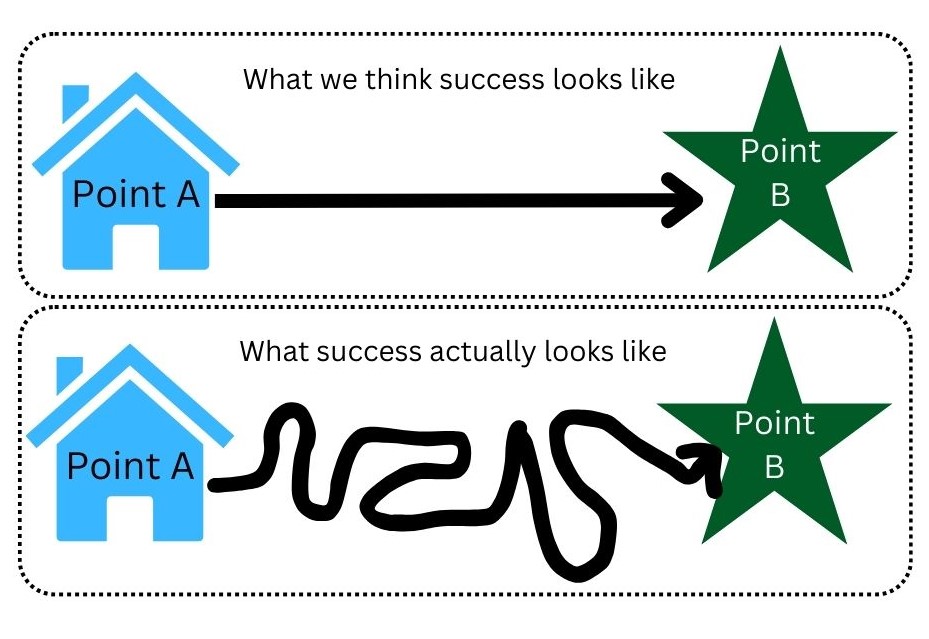
Getting from A to B: Overcoming the Daunting Gap

We’ve all been there. You set a big, ambitious goal that lights you up inside, but when it’s time to take action, point B feels so far away that you’re paralysed at point A. Yesterday, during a coaching call, I shared my own trepidation about some of the big goals I’ve set for myself, and the conversation uncovered a perspective that I want to share with you.

The truth is, getting from A to B is rarely, if ever, a straight line. Life doesn’t work that way. Obstacles, detours, and unexpected challenges are part of the journey. But none of that matters if you adopt a mindset of progress over perfection.

During the call, my coach reminded me of a quote often attributed to General Norman Schwarzkopf: “Plans are useless, but planning is essential.” The message? While no plan will ever unfold exactly as envisioned, the act of planning prepares you to adapt and take action. The only thing you truly need to do to move forward is to identify the best next step and take it.

Big goals often feel overwhelming because we focus too much on the vast distance between where we are and where we want to be. Instead, we need to narrow our focus to the next actionable step. When you’ve taken that step, identify the next one – and then the next. Progress happens one step at a time.

Consistency is the secret weapon here. Small, consistent actions compound over time to create significant results. Think of it this way: if you never leave point A, you’ll never reach point B. But each small step moves you closer to your goal and builds the momentum you need to keep going.

Taking stock of your progress at regular intervals is equally important. Pausing to reflect allows you to course correct, celebrate how far you’ve come, and re-align with your ultimate destination. It’s not about perfection; it’s about persistence.

This approach also works wonders when dealing with “writer’s block” or “analysis paralysis.” Both are rooted in fear – fear of getting it wrong, fear of imperfection, or fear of failure. But remember, inaction guarantees you’ll stay stuck. Moving forward, even imperfectly, is always better than standing still.

So as we step into 2025, let’s embrace the messiness of the journey. Let’s identify our big, bold goals, acknowledge the challenges ahead, and commit to action. Start by asking yourself: what is the best next step I can take today? Then take it.

Here’s to making 2025 our best year yet – for you and for me!

Mastery, Not Medals: A Shift in Perspective

Photo by Maksim Goncharenok on Pexels.com

As I mentioned in my last post, I’m currently in the process of writing a book – a collection of inspiring quotes that have profoundly influenced me. This project has been a labour of love, giving me the chance to reflect on the lessons these words carry. Each quote represents a moment of clarity, a shift in perspective, or a reminder of what truly matters in the pursuit of personal growth.

The most recent addition to this collection comes from running coach, Lawrence Van Lingen: “Mastery, not medals.” This phrase struck a chord with me because it captures a principle I’ve come to value deeply in both life and work. It reminds us that success isn’t just about reaching the finish line or collecting accolades – it’s about who we become along the way.

The Pursuit of Mastery

Mastery is about a continuous commitment to becoming better – whether as an athlete, professional, or simply as a person. Unlike medals, mastery isn’t a one-off event. It’s a lifelong journey, defined by resilience, persistence, and the quiet pride of knowing you’ve done the work. 

Chasing medals can bring moments of glory, but they’re often short-lived. The process of mastery, however, instils habits and builds a foundation that lasts far beyond the podium. It’s in the effort, the learning, and the incremental improvements that we discover our true potential.

Lessons from the Field

Whether it’s coaching young rugby players or working with clients in a professional capacity, I’ve found the same theme holds true. For young athletes, there’s often immense pressure to win, to rise through ranks, to collect trophies. But the real joy – and the lasting impact – comes from honing their skills, fostering teamwork, and building resilience.

Similarly, in my coaching journey, I started out wanting recognition. I thought success was about proving myself to others. But over time, I realised that the most meaningful achievements weren’t the moments of praise – they were the quiet, everyday efforts that led to personal and collective growth.

How to Embrace Mastery

If you’re looking to shift your focus from medals to mastery, here are a few ways to start:

  • Set Intentional Goals: Instead of targeting outcomes, aim for actions that build skills and character.
  • Celebrate Progress: Even small improvements deserve recognition – they’re the building blocks of mastery.
  • Be Patient: Mastery takes time. Embrace the gradual journey and avoid the temptation of shortcuts.
  • Reframe Challenges: View setbacks as lessons. They often teach us more than our successes do.

Moving Forward

If you find yourself chasing external validation, take a step back. Ask yourself: what would happen if you focused on the process instead? How would that shift impact your outlook, your growth, or your sense of fulfilment?

Van Lingen’s words are a powerful reminder that true success lies not in the medals we win but in the mastery we achieve along the way. When we let go of the need for constant recognition and instead embrace the pursuit of mastery, we unlock a deeper sense of accomplishment and purpose.

If you’re ready to explore what mastery looks like for you, I’d love to help. Get in touch today, and let’s start building a journey that’s meaningful, fulfilling, and uniquely yours.