As a coach, I often remind players to focus on what they can control – their effort, their mindset, their response to setbacks. But if I’m honest, this season has reminded me just how important that message is for me too.
One of the biggest learnings from the year has been the power of how I show up. I can’t control how much energy each player brings to training, how focused they are on a given day, or whether the weather plays nice. But I can control the way I plan a session. I can show up ready to adapt, to encourage, to bring energy even on the tougher days.
That’s not to say it always went smoothly. We’re all human – me, the players, the parents. There were times when things didn’t go to plan. Times when I sensed I was bringing a mood into training that I hadn’t quite shaken off. But that’s the beauty of being human too – the ability to catch ourselves, reset, and take a different tack.
This season, I made a conscious effort to notice when something wasn’t working and to be flexible enough to change direction. If a drill fell flat, I adjusted. If the group seemed a bit flat or distracted, we dialled down intensity and did something fun or competitive to lift the mood. When something did work, I made a point of banking it for future use.
Coaching youth rugby is as much about facilitating a learning environment as it is about teaching the game. That environment is shaped heavily by my presence, how I turn up, how I respond, and how I model behaviours I want the players to adopt.
This reflection has left me with a deeper respect for the ripple effect we have as coaches. When I show up with energy, curiosity, and patience, it usually comes back to me through the players. They mirror it. And when I don’t – well, that shows too.
So, one of the big takeaways for me this year is this: a session doesn’t begin when the whistle blows – it begins with me, long before that.
How are you showing up – not just when the players arrive, but in the quiet moments before that?
The season has officially drawn to a close. All that’s left are the end-of-season celebrations – the kit returns, thank-yous, and a few well-earned beers. It’s always a strange feeling, this pause after the final whistle of the last match. A moment to breathe, to look back, and to quietly ask the question: was it a successful season?
It’s not a straightforward question to answer. As a coach, I find myself looking at it from two angles – how the players experienced it, and how I did. And while I often say, “there’s no failure, just feedback,” the truth is that I wrestle with that idea myself sometimes. I’m only human, after all.
From the players’ perspective, success can look like many things: improved skills, growing confidence, friendships formed, games won, and challenges overcome. For me as a coach, it’s also about what I’ve learned, how I’ve grown, and whether I created the conditions for the girls to enjoy and develop through the game. That dual lens makes the word “success” a bit more layered – and perhaps that’s the point.
One of the most powerful lessons I’ve had to revisit this season is the difference between outcomes and ownership. I can’t control how hard the players work, how quickly they develop, or whether we win matches. But I can control the quality of the sessions, how I show up, the tone I set, and whether I stay open, adaptable, and encouraging – especially when things aren’t going to plan.
And things don’t always go to plan. Some sessions just don’t land. Sometimes we lose games we could have won. There are days when the energy just isn’t there. But being human also means we have the ability to course-correct, reflect, and try something new. Coaching is a living thing – not a fixed system to be followed, but a relationship to be nurtured
So when I ask myself whether this season was a success, the answer is yes – because I’ve seen growth. Not only in the girls’ ability on the pitch, but in their belief, their unity, and their willingness to keep going after tough games. I’ve seen flashes of brilliance, grit in defeat, kindness in how they support one another, and curiosity in how they want to improve.
If there’s one shift I’m holding onto as the season ends, it’s this: success in youth rugby doesn’t have to look like trophies or league tables. It can look like a new player falling in love with the game. A quiet player stepping into leadership. A team bouncing back after a late loss with more determination than ever. And it can look like a coach – still learning – sitting back with a full heart and thinking, we did alright, didn’t we?
There’s a patch at the bottom of our garden that’s been quietly taunting me for weeks. Brambles, knee-high grasses, and all the usual suspects of garden neglect had taken over. I kept looking at it, promising myself I’d tackle it “this weekend” – and then putting it off again. The job felt too big, too time-consuming, too something.
I bet you’ve had a similar experience. A task that looms large in your mind, growing more intimidating the longer it’s left. It might be a work project, a bit of DIY, or even just that email you’ve been avoiding. We talk ourselves out of starting because we convince ourselves we won’t have the time, energy, or motivation to finish. But here’s the thing: once we start, the rest usually follows.
Starting is the hard part
Yesterday, I finally decided to stop overthinking and just begin. I didn’t set out to finish the whole thing – that felt too ambitious. I simply committed to making a dent in it. The sky looked like rain, which was the perfect excuse to expect interruptions. So I lowered my expectations, grabbed my gloves, plugged into a podcast, and got going.
And something shifted.
Once I was in motion, momentum took over. It was easier to keep going than it had been to begin. I wasn’t thinking about how much was left or how I’d rather be doing something else. I was in it – and before I knew it, the job was done. Not just a dent, but all of it. Rain arrived, but only once I’d finished. Brambles were cleared. And that looming task? Gone.
Why we avoid starting
Avoidance isn’t laziness. It’s often rooted in perfectionism, fear of failure, or the belief that we won’t have the time to finish properly. We want to wait until we have a clear stretch, the right tools, or just feel more “ready.” But more often than not, that moment doesn’t arrive. So the task sits there, quietly growing heavier on our minds.
Reframing the task
A useful shift in mindset is this: don’t aim to finish, aim to start. That simple reframe relieves the pressure. By committing to ten minutes or one small section, you’re lowering the barrier to action. And once you’re moving, you may find, like I did, that momentum carries you further than expected.
Tactics that help:
Break it down: Instead of “clear the garden,” try “spend 15 minutes trimming brambles.”
Pair it with pleasure: A podcast, music, or cup of tea can turn it into something enjoyable.
Lower the bar: Starting with a small win can trigger a domino effect.
Acknowledge the resistance: Name the hesitation, but don’t let it drive the bus.
From garden to life
It might have just been a garden, but the principle applies everywhere. Whether it’s that email, a difficult conversation, or your next big idea, progress starts the same way: with a single step. We don’t need to know how it ends, we just need to begin.
Final thoughts
So if there’s something you’ve been avoiding, try this: don’t aim to finish it, just start it. Do the smallest, easiest version of the task. Make it so simple you can’t talk yourself out of it. And then see what happens.
Chances are, the only hard part is getting started.
This morning, while making coffee, getting ready for the day, I popped my headphones on and hit shuffle on Spotify. I wasn’t looking for anything in particular – just something to accompany the clink of the spoon in my mug. And then, out of the blue, Queen’s I Want It All came on.
It wasn’t what I’d planned to listen to, but I let it play. The song dragged me straight back to my teenage years. On a whim, I tapped ‘Go to Album’ – and that’s when I stumbled into something unexpected. A treasure trove of original takes from Queen’s The Miracle. Familiar songs, yes – but not quite the versions we all know. The lyrics were different. The tone was raw. Some takes felt unfinished, experimental, even uncertain.
And yet, I was captivated.
The Rough Takes We Rarely See
We often encounter creativity in its final, polished form. The chart-topping single, the bestselling novel, the sleek product in a shop window. What we don’t often see is the messy middle – the false starts, the rewrites, the discarded drafts, the awkward riffs that never made it past rehearsal.
Listening to Queen’s early takes was like sneaking a look behind the curtain. These were the rough beginnings of songs that would eventually become iconic. Hearing them in this raw state didn’t diminish their brilliance – it enhanced it. It made me appreciate the journey it takes to create something worthwhile.
It made me wonder: how many great ideas are abandoned because they didn’t come out “right” the first time?
One and Done? Not Likely.
We live in a culture that celebrates the highlight reel. Success stories are told in reverse – from the mountaintop down. Rarely do we hear about the scrambles, slips, and backtracks along the way.
And yet, creativity – real creativity – is rarely a one-and-done experience.
Whether it’s a song, a business idea, a painting, or a blog post, the first version is almost never the final version. The process is iterative. You begin with a spark, however small. You test. You tweak. You fail. You learn. You keep going.
Think of any creative process like sculpting. The masterpiece starts as a lump of clay. The form takes shape only through patient chipping, smoothing, and reworking.
Embracing the Process (and the Bins Along the Way)
Let’s be honest: facing a rough draft can be disheartening. It’s tempting to bin it, to say it’s not good enough, that you’re not good enough. But maybe that messy beginning is exactly what you need. It’s not a sign of failure, it’s a sign that you’ve started.
And starting is everything.
From there, the real work begins. Not glamorous, not always fun, but essential. You listen back, read through, assess. You keep the good. You refine the rest. You bin what doesn’t serve the vision. And you repeat.
Every artist has their ‘bins’, literal or metaphorical, full of unused verses, scrapped canvases, or sidelined ideas. But those abandoned parts weren’t wasted. They were stepping stones. They taught the artist what didn’t work so they could better uncover what did.
Keep Moving: Progress Over Perfection
The two most important steps in any creative journey are deceptively simple: start, and keep going.
Perfection is seductive. It whispers that unless something is flawless, it’s not worth finishing. But perfection isn’t the goal, progress is. Growth is. Discovery is.
There’s power in continuing. Power in showing up again, tweaking the chorus, rephrasing the sentence, redrawing the sketch. The more you create, the more you learn. And the more you learn, the closer you get to that final, polished version, the one the world might eventually admire.
Conclusion: Your Version of a Masterpiece
So here’s the question: what are you working on? What idea have you sidelined because the first take didn’t land? What draft lies forgotten in a folder somewhere?
Dust it off. Have another look. And if it’s still not quite right? That’s okay. Keep going.
Creativity isn’t about brilliance on the first try. It’s about the courage to begin, and the grit to keep refining. That Queen album reminded me of something powerful, that even the greatest start rough. The final masterpiece is the reward of patience, persistence, and belief.
Whatever you’re creating, keep moving forward. The world might not see your early takes. But they’ll feel the heart you put into the finished piece.
There’s something about a bright spring afternoon in the countryside that has a way of quieting the mind – if we let it.
This last weekend, our family took a trip to Winkworth Arboretum in the Surrey Hills. It was one of those unexpectedly perfect days – mild, sunny, and serene. The kind of day that invites you to breathe a little deeper, slow your pace, and tune into the world around you.
At one point, lying back on the grass and looking up at the sky, I wasn’t thinking of anything in particular, I was just… there. It felt calm, quiet, peaceful. Then – just like that – I thought about the drive home. Roadworks. Diversions. Traffic. And suddenly that peaceful state evaporated. My shoulders tensed. My brain whirred. The contrast was startling. Nothing had physically changed – I was still lying there under the same blue sky – but internally, it felt like a different world.
“Now Is All That Exists”
That shift brought to mind something I’d heard Dr Bill Pettit say in a recent webinar: “Now is all that exists.”
It’s a phrase I’ve heard in many guises over the years, often dismissed as a nice idea – uplifting but not all that practical. But recently, it’s started to resonate more deeply. Especially as I explore the link between thought and experience, and how our internal dialogue shapes the world we perceive.
What was creating that sense of calm on the one hand, and the feeling of dread a moment later? As Jamie Smart puts it in Clarity, our feelings come from thought taking form in the moment — not from our circumstances. When I was absorbed in the blue sky, the birdsong, and the rustle of the leaves, I was present, and all was calm. The moment my thoughts jumped ahead to potential traffic, the frustration crept in. But it wasn’t the traffic — it hadn’t even happened yet. It was just my thinking in that moment, doing what thinking does.
We Live in the Feeling of Our Thinking
This is an easy truth to overlook, especially when life gets busy. We blame the traffic, the looming deadlines, the difficult conversation we had last week. But if we stop and look a little closer, we realise: stress isn’t coming from the outside. It’s coming from inside – from the way we’re thinking about what’s outside.
That afternoon, when I stayed rooted in the present – the sounds of the birds, the feel of the grass, the laughter of my daughters – there was nothing to fix, nothing to worry about. Just life, unfolding as it does, one breath at a time.
Focus on the Next Step, Not the Whole Hill
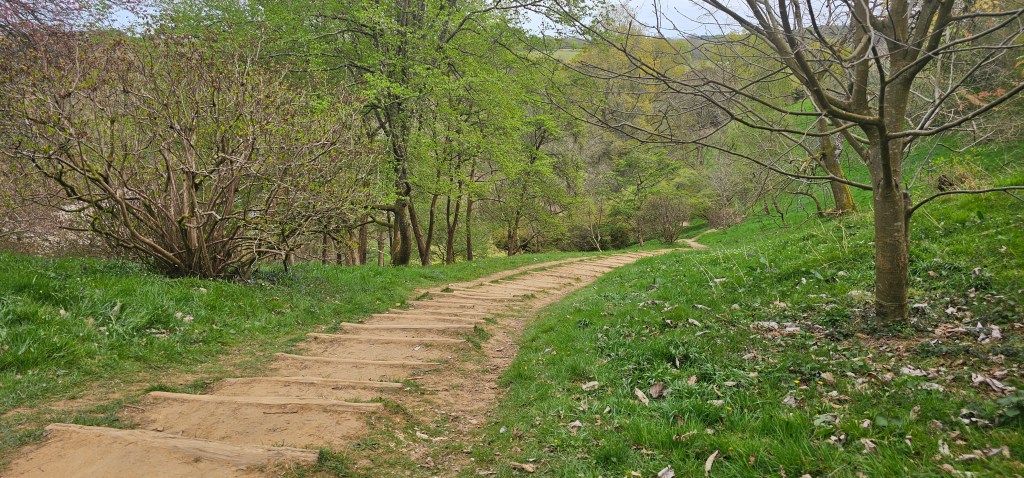
Later that day, I followed my youngest daughter down a steep path. As we descended, I was acutely aware of one thing: we’d have to walk back up. Given my current level of fitness (a work-in-progress, let’s say), I knew that was going to be a challenge.
But as we made our way up again, I instinctively returned to an old habit from my cycling days: keep your eyes just ahead, and focus on the next few metres. Don’t stare at the top. While the summit can feel overwhelming, the next step rarely does.
That mindset carried me through. The climb was still tough, but it was also energising. I could feel my legs working, my heart pumping, my breath quickening – but I was in it. And with each step, I felt more alive.
The Present Moment Is Where Life Happens
Whether it’s climbing a hill or facing the everyday demands of modern life, the present moment is our anchor. The past is done. The future is imagined. All we truly have is now. And yet we spend so much of our time outside of it.
There’s an old saying: “Worrying is like a rocking chair – it gives you something to do but doesn’t get you anywhere.”
That rings true. Worry might feel like preparation or control, but it’s usually just mental noise that keeps us from fully engaging with life as it is, not as we fear it might become.
Conclusion: The Gift of Being Here
That afternoon in the Surrey Hills was a quiet reminder of something powerful: life happens in moments, not plans. We don’t need to eliminate thought, or control it – but recognising when we’re getting caught in imagined futures or recycled pasts can help us gently return to the here and now.
So whether you’re lying under a wide blue sky or stuck in traffic (real or imagined), notice where your attention is. Can you come back to your breath? To the next step? To what’s directly in front of you?
Because now really is all that exists – and it might just be more peaceful than you think.


 Patrick Hickman