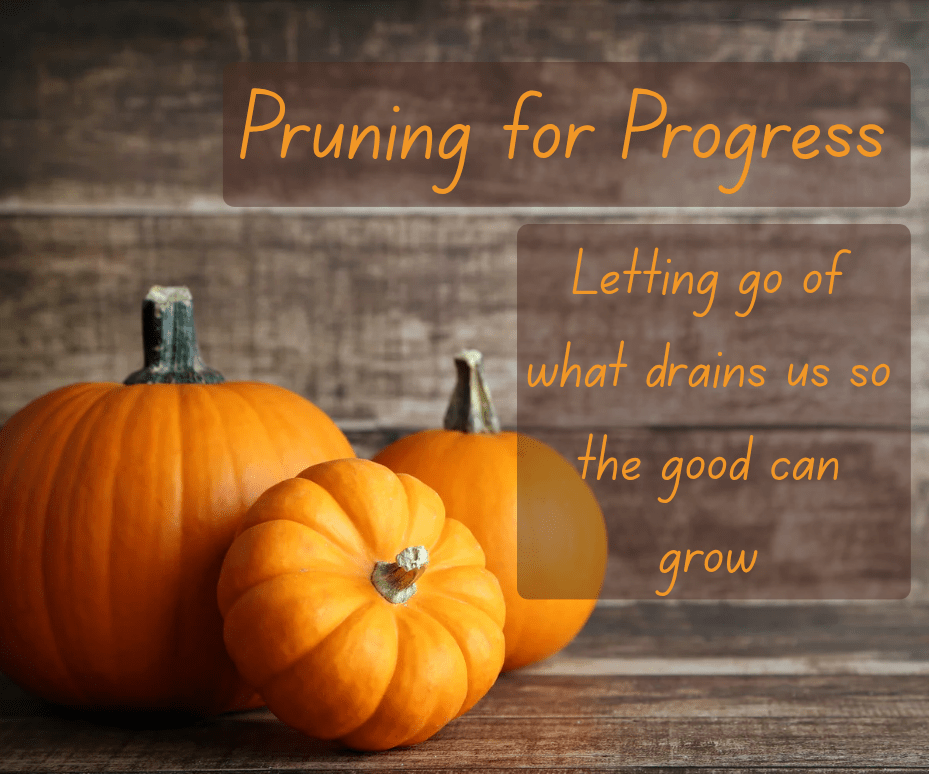
I came across a post on by Steven Bartlett Facebook the other day that caught my attention. One of those deceptively simple posts that seems obvious at first glance. My initial reaction was, “Yes, that feels true.” Then I read the comments and the idea took on more depth and nuance than I first expected.
Those comments reminded me of a book I read some time ago called The Pumpkin Plan by Mike Michalowicz. In it, Michalowicz compares building a successful business to growing award-winning giant pumpkins. The key insight is not about adding more. It is about removing. To grow one exceptional pumpkin you have to cut away the others. Those smaller pumpkins might look promising but they drain nutrients from the one that has the real potential. If you leave them all, none of them truly thrive.
Several comments under Steven’s post pointed to this principle in gardening. Healthy growth is not just about watering and feeding. Timely, thoughtful pruning encourages stronger, more vibrant results. Cut back the right things, at the right time, and the whole plant benefits.
That idea translates easily into life, sport and work.
As a coach, both in a personal sense and on the grassroots rugby pitch, I see this regularly. We often focus on what we should add. More sessions, more conversations, more commitments, more effort. Rarely do we pause to consider what might need pruning. What is quietly draining energy without offering much in return.
Most of us can think of people, habits or expectations that have this effect. Individuals who find fault in what we do, question our intentions or consistently ask more from us than they give back. This is where the topic becomes uncomfortable, because it is easy to drift into extremes. Cut people off. Walk away. Be ruthless.
That is not what I am advocating.
There are many situations where giving, even when it is not balanced, brings genuine satisfaction. Parenting, volunteering, coaching young players, supporting friends through difficult periods. These relationships are not transactional and they should not be treated as such. The challenge arises when giving happens against a backdrop of resistance, negativity or obstruction. When you start to feel depleted, frustrated or wondering why you bother at all.
When that happens, I try to return to first principles. Why am I doing this? What matters to me here? What is actually within my control?
This is where a simple idea from Mel Robbins has been helpful. Let Them. Let people think what they think. Let them say what they say. Let them behave how they choose to behave. Then comes the more important part. Let Me. Let me act in line with my values. Let me invest my energy where it makes sense. Let me step back from what undermines healthy growth.
In a grassroots rugby environment, this might mean spending less time trying to persuade a resistant parent and more time supporting players who are open, curious and committed. In work, it could mean saying no to projects that look attractive but pull you away from what you do best. In life, it might involve creating a bit more distance from conversations that leave you feeling drained rather than steady.
Pruning is not about punishment. It is about clarity. It is about protecting what matters so it has the space to grow.
If there is one simple takeaway, it is this. When you feel stretched, frustrated or stuck, ask yourself what needs cutting back, not what needs adding. Progress often comes not from doing more, but from choosing more carefully.
 Patrick Hickman